
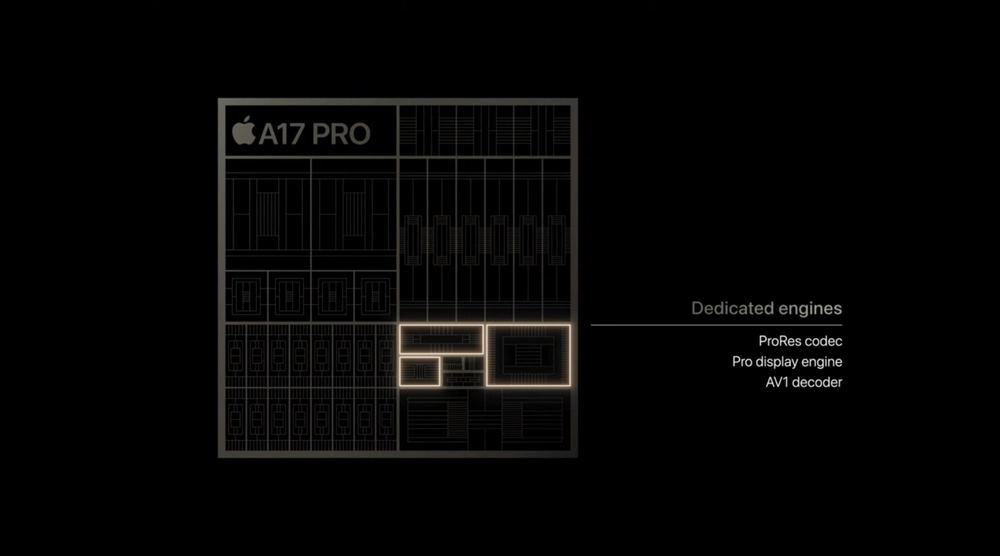

In 2018, Apple joined the Alliance for Open Media (AOM), the group behind AV1. Adoption was slow at first, but Apple has added AV1 hardware to its chips over the last few years. From the A17 Pro to the new M5 chips released in March 2026, software-only decoding and encoding is no longer necessary.
Apple has moved from limited support to standard support over the last two years. While the A17 Pro (iPhone 15 Pro) and M3 family introduced hardware decoding, the most recent updates expand this further:
AV1 is the state-of-the-art video technology that uses high compression to deliver 4K and 8K video at lower bitrates than H.264 or HEVC. With Apple's AV1 hardware decoding, you can enjoy the following benefits:
Since the AV1 video is highly compressed, decoding the file requires more resources. Hardware decoding is more power-efficient for this than software decoding. At the same time, it generates less heat, which is essential for maintaining the performance and lifespan of the device. In other words, streaming 4K video from YouTube or Netflix no longer drains your battery rapidly.
Hardware decoding provides smoother playback of AV1-encoded videos, especially at higher resolutions (such as 4K and above). It reduces latency in video playback and streaming, so you can get "real-time" video conferencing, live streaming, etc.
As AV1 is increasingly adopted by streaming services (such as Netflix, YouTube, etc.) and becomes the standard for web video, having hardware support ensures that devices can handle new content without the need for software updates or additional computing power.
Since AV1 is more efficient in data compression, users can enjoy higher-quality video streaming even on bandwidth-constrained networks.
Yes. High-end Apple Silicon, specifically the M4 Ultra, M5 Pro, and M5 Max, now includes dedicated AV1 hardware encoders.
Yet, older M1, M2, and standard M3/M4 Macs still rely on software encoding (CPU). In these cases, tools like WonderFox HD Video Converter Factory Pro (Windows) or HandBrake (Mac) remain essential. They allow you to convert older movies into AV1 format, though the process will be slower on devices without the M5-series encoding engine.
Current models (iPhone 16/17, M3/M4/M5 Macs) handle AV1 effortlessly. But if you are using an older device like an iPhone 14 or an M2 MacBook, you have two options:
Yes. All M5 models support hardware decoding. Also, the M5 Pro and M5 Max models (and the M4 Ultra) support hardware-accelerated AV1 encoding for the first time.
No. Only iPhone 15 Pro and Pro Max support AV1. But if you have an iPhone 16 or iPhone 17 (standard or Pro), hardware AV1 support is included.
AV1 is indeed better than H265 in terms of compression and quality, roughly 30% more efficient than H.265. This makes AV1 more suitable for video streaming. However, AV1 requires more computing power to encode and decode than H.265, which is not very friendly to low-end devices.
WonderFox
HD Video Converter Factory Pro
 Download for FreeDownload for Free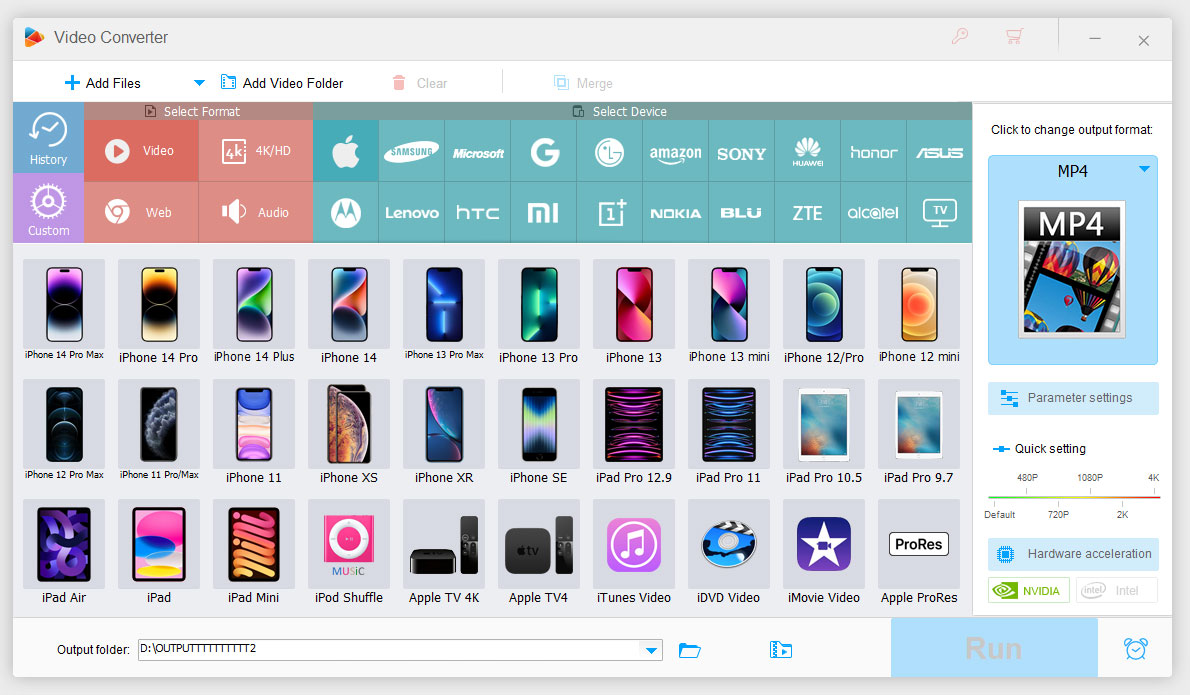

Terms and Conditions | Privacy Policy | License Agreement | Copyright © 2009-2026 WonderFox Soft, Inc. All Rights Reserved.




