

APE files must be no stranger to many music enthusiasts. Though these files keep high quality with lossless compression, they are not well supported by many phones, portable players, editors, and Apple apps. That is why you may need to convert APE to a more recognizable audio format like MP3, WAV, FLAC, ALAC, AAC, etc. Next, we'll take you through several practical ways to convert APE files without difficulty.
 Kevincy | Updated on Jun 10, 2026
Audio files come in different formats, with APE being one of the less common ones. APE stands for Monkey's Audio, a lossless audio format designed to reduce file size without throwing away audio data. This is useful for music backup, but the downside is obvious: many media players, mobile devices, editing programs, and Apple apps cannot open APE files unless a suitable codec, plug-in, or component is installed.
Instead of struggling with playback errors or unsupported-file messages, you can convert APE audio files to a more suitable format. Use MP3 when you want smaller files and broad compatibility, WAV when you need an uncompressed file for editing, FLAC when you want a widely supported lossless archive, or ALAC when you want lossless playback in the Apple ecosystem. Below, we will explore several free APE converters and show you how to handle common conversions such as APE to MP3, APE to WAV, and APE to ALAC.
MP3 is lossy, but it works almost everywhere and saves much more storage space. If you want to listen on a phone, car stereo, smart TV, or portable player, MP3 is usually the safest choice. For music, 256kbps or 320kbps is a practical balance between quality and size.
WAV is usually uncompressed PCM audio. Converting APE to WAV does not improve the sound, but it gives you a format that is easy to open in most audio editors, DAWs, and CD-burning tools. The trade-off is a much larger file size.
FLAC and ALAC are both lossless formats. FLAC is great for general music archiving and many hi-fi players. ALAC is better for Apple Music, iTunes, iPhone, iPad, and other Apple devices. Note that ALAC audio is commonly saved with the .m4a extension because ALAC is a codec, not a standalone container.
As a GUI-based novice-oriented video and audio processor, Free HD Video Converter Factory offers a 3-step process to convert APE files to common audio formats without a hitch. Get this freeware, video and audio format conversion is no longer a problem!
If you're looking for a no-brainer to convert APE files, look no further than WonderFox Free HD Video Converter Factory. This software is not only powerful but also completely free, which means anyone can use it without costing a dime. It enables you to convert APE to MP3, WAV, FLAC, AAC, M4A, and other common formats in just a few clicks. The software's intuitive user interface is designed to cater to both tech-savvy professionals and novice users alike, making it easy to navigate regardless of your level of experience.
DownloadDownload, install, and launch Free HD Video Converter Factory. Open the "Converter" module and press the "Add Files" button or simply drag and drop your APE files into the conversion workplace.

After loaded, press the "Format Profile" on the right side to open the format library. From the 500+ configured presets, navigate to the "Audio" category and choose a desired audio format for export.
For example, choose MP3 for broad compatibility and small size, WAV for uncompressed editing, FLAC for lossless storage, or AAC/M4A for mobile playback.

Click on the Down Arrow icon on the bottom to choose a destination folder. Finally, hit the "Run" button to start converting APE files effortlessly.

Another option you can use is Audacity, a popular free and open-source digital audio editor, that allows you to record, edit, and convert audio files. However, if you're new to Audacity, converting APE files might seem less straightforward than using a dedicated converter. Depending on your Audacity version and system setup, you may need FFmpeg for Audacity to import APE files and export some formats. Next, we'll walk you through the steps of converting APE files with Audacity.
Step 1. Audacity is available for Windows, Mac, and Linux. If you haven't already, download and install Audacity from the Official Website.
Step 2. Before start, download and install the FFmpeg for Audacity plug-in to ensure that you can import APE files and export more audio formats.
Step 3. Open Audacity and select "File" from the top menu bar, then click "Import" and select "Audio." Browse to the location of the APE file on your computer and select it. Audacity will import the file and display it as a waveform. You can also drag and drop multiple APE files into Audacity window.
Optional. If you need to make any edits to the audio files before exporting, use Audacity's editing tools. For example, you can trim the beginning or end of the file, normalize the volume, split/merge tracks, or apply effects like Reverb or Distortion.
Step 4. To convert the APE files to a different format, select "File" from the top menu bar and click "Export". You can also choose "Export Multiple" for batch APE files conversion.
Step 5. Choose the format you want to convert to, such as MP3 or WAV, and select a location on your computer to save the new file.
Step 6. Choose your preferred options to personalize the output files. Then click "Export" to start the conversion process. Audacity will convert and process the APE files.

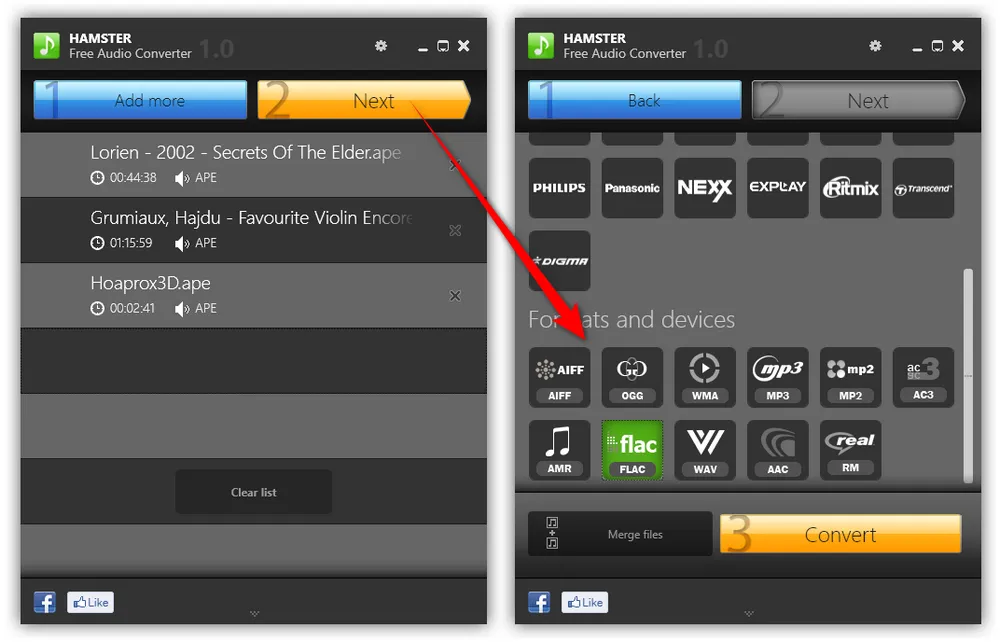
If you're looking for a reliable APE file converter, Hamster Free Audio Converter is definitely worth considering. It is also recommended to convert audio files to a variety of formats, including APE. Whether you're a beginner or an experienced user, you can use this software to get the job done quickly and easily.
Step 1. Since Hamster Free Audio Converter is no longer available from its official website, download it only from a source you trust and scan the installer before running it. If you prefer an actively maintained tool, consider fre:ac, VLC, MediaHuman Audio Converter, or Free HD Video Converter Factory instead.
Step 2. Run Hamster Free Audio Converter, press "Add Files" button or drag and drop the APE files into the main window. You can add multiple files at once.
Step 3. After loaded, click on the "Next" button on the top of the program.
Step 4. Scroll down the window and choose any preferred audio format for the conversion.
Step 5. Press the "Convert" button to choose the destination folder where you want to save the converted files.
Step 6. Click OK to start the APE audio files conversion. The conversion time will depend on the size of the APE files. When the process is complete, you'll be prompted to go to the location.
MediaHuman Audio Converter is also a great application that can help you convert APE files with ease. It's available for both Windows and Mac, and can also convert other audio formats, such as WAV, FLAC, AAC, and more. It also has a feature that can automatically split APE files based on CUE files. Simply follow the instructions to start the conversion.
Step 1. Download and install MediaHuman Audio Converter from the Official Website.
Step 2. Launch the software and click the + button on the toolbar to add the APE files you want to convert. You can also drag and drop them from your file explorer.
Step 3. Click the wrench icon on the toolbar to open the Preferences window to adjust the output settings. Choose an output format like MP3 and set the quality and bitrate according to your preference.
Step 4. Specify an output folder to save the converted files. You can also enable the option to search for cover art online and add it to your MP3 files. Click OK to save the changes.
Step 5. Click the Start conversion button on the toolbar to begin the conversion process. You can monitor the progress and status of the conversion in the main window.
Step 6. When the conversion is done, you can click the Magnifier button to open the output folder you've defined.

I bet most people are more familiar with VLC media player. As you know, VLC is a free and open source media player that can play the majority of video and audio files. Fortunately, it also works as an APE audio converter that allows you to convert APE files into more widely compatible formats like MP3, WAV, and FLAC. You don't need any additional software if you have VLC installed already.
Step 1. Launch the VLC media player. Click the Media menu in the top-left corner of the window and choose Convert / Save.
Step 2. In the Open Media dialog, click the + Add button and browse for your APE files. You can also drag and drop the files into the dialog. Click Convert / Save to continue.
Step 3. In the Convert dialog, click the Profile drop-down menu and select one audio profile. VLC natively offers several options for audio conversion, such as OGG, MP3, FLAC, and WAV. You can also click the Wrench icon to adjust the audio parameters such as bitrate, channels, and sample rate. If VLC fails to decode a specific APE file, try another converter listed in this article.
Step 4. Click on the "Browse" button to choose a destination folder and change file name for your output files. But they can't be changed if you've added multiple APE files in Step 2 for batch conversion. In this case, the converted files will be saved in the same location with the original APE files.
Step 5. Click the Start button to begin the APE conversion process. You can see the progress bar at the bottom of the VLC window.

Apart from editing and converting APE files, Free HD Video Converter Factory even allows you to download HD/FHD/UHD music videos and songs/albums/mixtapes/audiobooks from YouTube and 500+ popular sites. All of these are 100% FREE!
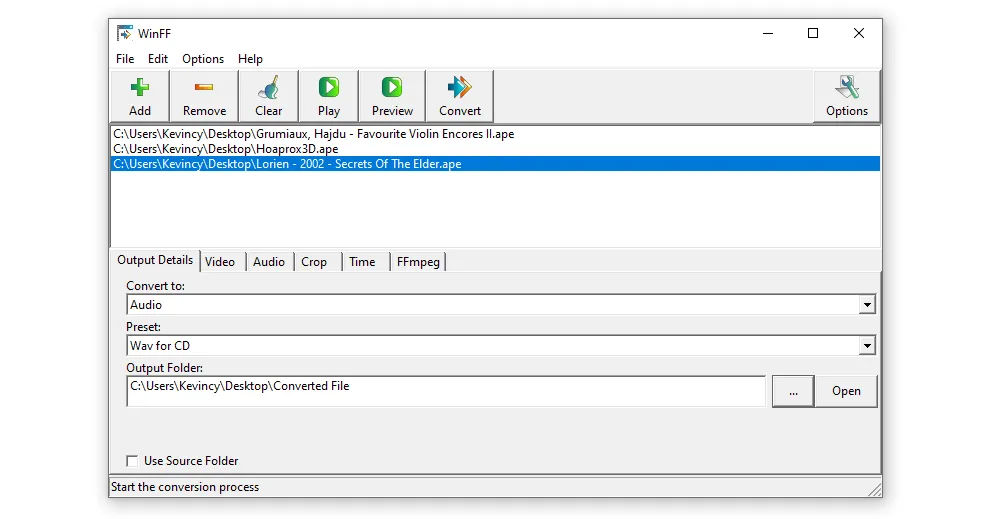
Cannot handle those hard-to-remember FFmpeg scripts? No worries, WinFF is a free GUI front-end for the command line video converter FFmpeg or avconv, which can also convert audio files between different formats on Windows, Debian, and Ubuntu. WinFF takes care of all the technicalities to execute the APE file conversion for you, just follow these steps below.
Step 1. Download and install WinFF from its official website or a trusted software archive. Since WinFF has not been actively developed for years, it is better kept as an optional choice rather than the first recommendation.
Step 2. Launch WinFF and click on the Add button to browse and select the APE files you want to convert. You can also drag and drop the files to the WinFF window.
Step 3. In the drop-down list of "Convert to" section, select "Audio" option.
Step 4. From the Presets drop-down menu, select OGG, MP3, WAV, or any other format that suits your needs. Since WinFF is no longer developed, there is only a limited number of options right there.
Step 5. Designate a location to save the converted files.
Step 6. Click on the Convert button to start the conversion process. A command line window will pop up and show the progress of the conversion. When the conversion is done, the window will close automatically and you can find the converted files in the output folder.
Monkey's Audio is a lightweight and powerful lossless audio compressor that can compress and decompress audio files without sacrificing their quality. Unlike other APE audio file converters mentioned above, the Windows-based app only allows converting a limited number of files to APE format. To convert audio files with Monkey's Audio, you can follow these steps.
Step 1. Download and install Monkey's Audio from its Official Website.
Step 2. Launch the program and click on the Mode menu on the top of the window.
Step 3. Select "Compress", "Convert", or "Decompress" mode, depending on what you want to do. We'll take "Convert" as the example here.
Step 4. Select the audio file(s) you want to convert by clicking on the "Add Files" button or dragging them into the program window. The "Convert Mode" support importing APE, APL, ALAC, FLAC, TAK, and WV files.
Step 5. Choose a compression level from fast, normal, high, extra high, or insane.
Step 6. Open "Options" window and go to "Output" section to choose a location for saving the output files.
Step 7. Finally, hit "Convert" button to convert audio files to APE format.

fre:ac is well-known as a free and open source audio converter and CD ripper that supports various popular formats and encoders. It's an excellent choice for converting audio files between APE and other common formats on Windows, macOS, Linux, FreeBSD, and Haiku. It's easy to learn and use, even offers expert options when you need them. Here's a simple guide to help you out.
Step 1. To begin, download and install fre:ac on your computer from its Official Website.
Step 2. Launch fre:ac and click on the "Add Files" button. Browse and select the APE files you want to convert. You can add multiple files at once by holding down the "Ctrl" key or just perform a drag-and-drop action.
Step 3. Select any desired output format you want to convert the APE files to from the drop-down menu under "Selected encoder". You can choose from a wide range of formats like MP3, FLAC, ALAC, AAC, WAV, etc.
Optional. Click on the "Configure selected encoder" button to customize the output settings like bitrate, quality, codec, etc. You can skip it if you're not sure what to choose.
Step 4. Click on the "Select" button at the bottom of fre:ac to choose a folder where you want to save the converted files.
Step 5. Click on the "Start Encoding" button to begin the APE files conversion. You can monitor the progress and status of the conversion in the fre:ac window. Once the conversion is done, you can find the converted files in the output folder you specified.

In addition to those desktop freeware, there are also many online tools available that can help you convert APE files online to your desired format without installing any software. They are convenient for one or two small files, but large APE albums may upload slowly or exceed the free size limit. Also, avoid uploading private or copyrighted audio to an online service you do not trust. Typically, online APE converters share the same operation steps as follows.
Step 1. Find a reputable online audio converter that supports APE files and open the website on your browser. Some popular online converters include Zamzar, Online-Convert, Convertio, etc.
Step 2. Upload the APE files you want to convert to the online tool. Most conversion tools will have a simple drag-and-drop interface that makes this step easy.
Step 3. Select the output format you want. Depending on the tool you are using, you may have several options to choose from. Popular formats include MP3, WAV, FLAC, and more.
Step 4. Customize the settings. Depending on the tool, you may be able to customize the sample rate, bitrate, or other settings to optimize the output for your needs.
Step 5. Once you have selected the output format and customized the settings, you can start the uploading and conversion process. Depending on the size of the files and your internet connection, this process may take several minutes.
Step 6. Once the conversion is complete, you will be able to download the new files in your selected format. Be sure to save them to a location on your computer or device where you can easily find them.

To make your APE file conversion process smoother and more efficient, here are some tips below:
If you have multiple APE files to convert, use software that supports batch conversion. This saves time by processing all files simultaneously, especially when converting a full APE music library to MP3, FLAC, WAV, or ALAC.
Different audio formats serve distinct purposes. Converting APE to WAV, FLAC, or ALAC is lossless, so the decoded audio quality can remain the same. Converting APE to MP3 or AAC is lossy, so choose a higher bitrate, such as 256kbps or 320kbps for MP3, if you want better listening quality.
For editing and CD authoring, WAV is usually the easiest format to handle. For smaller everyday files, MP3 is still the most compatible choice. For lossless storage outside Apple devices, FLAC is usually more convenient than APE. For Apple Music, iTunes, iPhone, iPad, and Apple TV, ALAC in an M4A container is the better match.
Some APE albums come as one large .ape file with a .cue sheet. If you want individual songs instead of one long track, use a converter that can read CUE information or split the file before conversion. MediaHuman Audio Converter, fre:ac, Foobar2000, and XLD are common choices for this job.
Some conversion tools, such as Audacity and MediaHuman Audio Converter, allow you to edit metadata like title, artist, album, and track number during the conversion process. It is worth checking the tags before you move the converted files to a music library.
WonderFox Free HD Video Converter Factory is a 3-in-1 novice-oriented A/V processing toolkit for video and music downloading, editing, and converting. GET IT NOW, it won't let you down.
A: By default, iTunes and Apple Music do not support the APE format. You can use an APE converter to convert APE files to an iTunes-friendly format, such as ALAC, WAV, AIFF, MP3, AAC, or M4A.
A: ALAC is a codec, while M4A is a container. In most cases, Apple Lossless audio is stored in an .m4a file. So an .m4a file can be either lossy AAC or lossless ALAC, depending on the codec inside.
A: It depends on the output format. APE to WAV, FLAC, or ALAC is a lossless conversion, so it should not reduce audio quality. APE to MP3 or AAC is lossy, so some audio data will be removed to make the file smaller.
A: There is no single best format for everyone. Choose MP3 for universal playback and small size, WAV for editing, FLAC for a lossless library, and ALAC/M4A for Apple devices and Apple Music.
A: The freeware mentioned in the article is generally safe when downloaded from official websites or trusted sources. For discontinued software or third-party download mirrors, always check the installer carefully and avoid bundled offers you do not need.
A: Yes. Most online converters have maximum file size limits, which can range from a few MB to several GBs. Check the file size limits of the online converter before uploading your APE files. If you need to convert large APE albums or many files, a desktop application is usually faster and more stable.
That's it! An APE file converter is useful when you want to make APE music easier to play, edit, archive, or transfer to Apple devices. For smaller and more compatible files, convert APE to MP3. For editing or CD-related work, convert APE to WAV. For lossless storage, choose FLAC or ALAC depending on your playback environment. The best part is that most tools recommended above are free to use, so you can choose the right one based on your needs and start the conversion without extra cost.

Kevincy joined the WonderFox team in 2014 and has been a senior columnist ever since. With over two decades of experience in the video editing industry, he shares tutorials, tips, and how-to guides on video/audio processing and personal DVD backups. Family-oriented and passionate about helping others, he is dedicated to making video and audio processing easier for readers.


Kevincy joined the WonderFox team in 2014 and has been a senior columnist ever since. With over two decades of experience in the video editing industry, he shares tutorials, tips, and how-to guides on video/audio processing and personal DVD backups. Family-oriented and passionate about helping others, he is dedicated to making video and audio processing easier for readers.

WonderFox HD Video Converter Factory Pro
1. 500+ optimized presets for fast conversion in bulk.
2. Compress large-sized videos with no quality loss.
3. Trim, merge, crop, rotate, flip, watermark video.
4. Download HD/FHD/4K/8K videos from 1000+ sites.
5. Record live streams, gameplay, webcam, video call
6. Make animated GIFs from video or image sequence.
7. Make ringtones, extract subtitles & more...

Privacy Policy | Copyright © 2009-2026 WonderFox Soft, Inc. All Rights Reserved
